
Printed Leather Patches
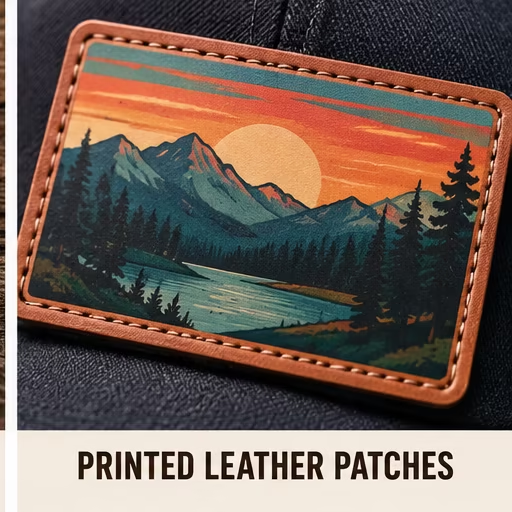
Printed leather patches are leather or faux leather emblems with artwork reproduced in ink on the surface. Print is useful when several colours, gradients or image details carry the brand identity and a tonal pressed impression would lose essential information.
On this page · 13 sections
- What Are Printed Leather Patches?
- How Printing Works on Leather
- When to Choose Print Instead of Debossing
- Full-Colour Logos, Gradients and Photographic Artwork
- Genuine vs Faux Leather for Printing
- Colour Accuracy and Brand Matching
- Durability and Abrasion
- Backing Options
- Best Uses
- Printed vs Colour-Filled Leather Patches
- Artwork Requirements
- FAQs
- Turn the details into a clear specification
What Are Printed Leather Patches?
Printed leather patches use ink to create the visible logo instead of relying only on surface depth. The material face must accept the chosen print system. A printed emblem can remain relatively flat while displaying artwork with several colours.
How Printing Works on Leather
Printing transfers a prepared image onto a compatible leather face. Surface preparation, ink behaviour and curing depend on the actual system used. Ask which process suits the chosen stock rather than assuming every leather accepts the same ink.
When to Choose Print Instead of Debossing
Choose print over debossing when colour differences are essential to understanding the logo. Debossing works through relief and shadow, so it cannot by itself reproduce a multicolour graphic. Print and pressing can also be different aesthetic choices for the same simple mark.
Full-Colour Logos, Gradients and Photographic Artwork
Full-colour logos and gradients require a process capable of reproducing tonal transitions. Photographs need sufficient image data at the finished size and a surface that does not obscure important detail. Simplify an image when the patch is too small for recognition.
Genuine vs Faux Leather for Printing
Both genuine and faux leather require surface compatibility checks before printing. A smooth, consistent face can help reproduce fine graphic edges, but coatings influence adhesion. Compare the completed print on the intended substrate rather than judging a blank swatch alone.
Colour Accuracy and Brand Matching
Colour accuracy depends on ink, substrate colour, texture and viewing conditions. Supply a recognised brand reference and identify the colours that matter most. A digital proof represents layout; a physical reference is needed to assess the printed result reliably.
Durability and Abrasion
Printed durability depends on the ink system, preparation, curing and exposure. Rubbing can affect a surface graphic differently from a recessed logo. Ask for appropriate care guidance and evidence relevant to the intended application rather than a general long-lasting claim.
Backing Options
Backing should suit the garment without compromising the printed face. Sewing needs a reserved perimeter; heat application requires a compatible print, substrate and adhesive combination. Confirm whether the application procedure can change the appearance of the artwork.
Best Uses
Printed patches suit colour-led clothing labels, bag emblems and promotional branding where a graphic must remain recognisable. Position the patch away from concentrated rubbing where practical. Select the material and care routine before finalising colour-dependent artwork.
Printed vs Colour-Filled Leather Patches
Printing places the design on the surface; colour filling places pigment within selected recesses. Print is a candidate for gradients and image-based graphics, while fill suits distinct colour shapes. Choose according to whether continuous colour or tactile depth matters more.
Artwork Requirements
Supply original vector artwork for logos or a sufficiently detailed raster image for photographs. Include dimensions, colour references and a clear cut contour. Check the image at actual size and confirm the required resolution with the chosen production process.
FAQs
Can a photograph be printed on leather?
A compatible process may reproduce it, but image resolution, patch size and surface texture limit the useful detail.
Will print wear off?
Wear depends on the ink system, curing and exposure. Ask for care and performance information for the exact construction.
Is a digital proof a colour sample?
No. It shows the proposed image and layout; physical colour requires a relevant material or printed reference.
Turn the details into a clear specification
Send your logo, dimensions and quantity with the finish choices discussed above. Include the receiving product and any wash or delivery requirements so the quotation can address your intended use.