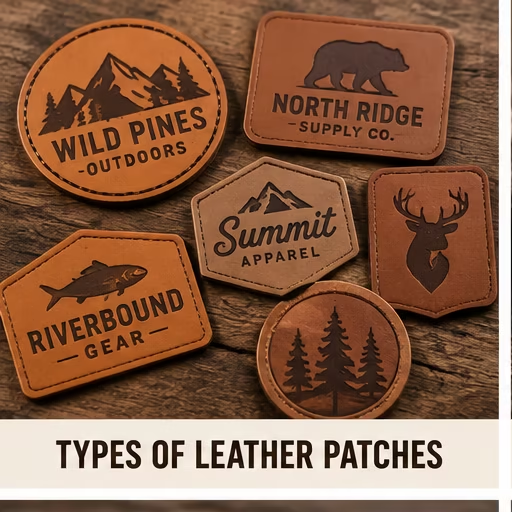
Types of Leather Patches
Leather patch types are defined mainly by how artwork is applied to the surface. Choose debossing for recessed logos, embossing for raised relief, laser engraving for detailed tonal marks, printing for colour artwork, and colour filling for coloured recesses.
On this page · 12 sections
- How Leather Patch Types Differ
- Debossed Leather Patches
- Embossed Leather Patches
- Laser-Engraved Leather Patches
- Printed Leather Patches
- Colour-Filled Leather Patches
- Which Leather Patch Finish Is Best for Your Logo?
- Which Finish Is Most Durable?
- Best Finish by Application
- Leather Patch Finish Comparison Table
- FAQs About Leather Patch Types
- Turn the details into a clear specification
How Leather Patch Types Differ
Leather patch finishes differ in depth, detail, colour and wear behaviour. A die changes the surface relief; a laser marks or removes surface material; ink introduces colour. These differences determine whether your artwork reads as a subtle impression or a contrasting graphic.
Surface depth
Surface depth distinguishes a recessed impression from raised relief or a comparatively flat printed mark. It changes how light reveals the logo.
Detail level
Detail depends on the smallest clear stroke and gap at actual size. Enlarged artwork can hide limitations that appear on the physical patch.
Colour capability
Tonal finishes rely on material and relief, while print and fill add colour. Decide which colour information is essential to recognising the logo.
Durability
Durability is a property of the complete material, finish and attachment in use. Evaluate the actual exposure and care routine instead of relying on a finish name.
Debossed Leather Patches
Debossing presses the logo below the surrounding leather. Broad lettering and clear negative space create a readable recess without relying on added ink. It suits restrained cap branding and denim labels where texture carries the design.
Embossed Leather Patches
Embossing leaves the logo above its surrounding background. The relief catches light and gives a tactile identity to bag labels and larger brand marks. Small counters and narrow raised lines need enough space to remain distinct.
Laser-Engraved Leather Patches
Laser engraving marks the leather along a digital artwork path. It can reproduce detailed lines without a dedicated logo die, but visible contrast depends on the exact substrate. A design sample is more useful than assuming every brown leather will engrave black.
Printed Leather Patches
Printing places ink on a compatible leather surface. It is useful when the relationship between several colours matters more than a recessed or raised impression. Gradients and photographic details need a suitable printing process and enough patch area.
Colour-Filled Leather Patches
Colour filling adds pigment to a recessed design. The depression defines the mark while the fill increases contrast. Separate, open shapes are easier to distinguish than many tiny adjoining colour areas.
Which Leather Patch Finish Is Best for Your Logo?
The best finish preserves the part of the logo that identifies the brand. Simplify fine decorative elements before abandoning a preferred finish. When colour is essential, compare print with colour filling; when texture is essential, compare the two pressed methods.
Simple logos
Simple logos usually give pressed finishes more space to form cleanly. Preserve the main silhouette and avoid unnecessary small decorative strokes.
Fine text and crests
Crests need separation between their internal elements. Test small lettering and linework at actual size, and simplify details that do not contribute to recognition.
Full-colour artwork
Full-colour graphics need a compatible reproduction process. Check whether gradients and image detail remain meaningful within the proposed patch area.
Which Finish Is Most Durable?
Finish durability depends on material, surface treatment, attachment and use. A recessed logo has no raised ink film unless filled, but the leather can still abrade or dry out. Judge a finished sample against the product’s actual handling and cleaning routine.
Best Finish by Application
Application changes the priorities of finish selection. A small cap patch needs a readable silhouette; a bag emblem can accommodate larger relief; frequently washed clothing needs a material and finish approved for its wash cycle.
Hats
A cap front needs a patch that follows the crown without crowding the peak or panel seams. Test the outline on the actual cap model.
Jeans
A jean waistband needs clearance for belt loops and a usable stitch margin. Check dye transfer and the garment wash process before choosing a label material.
Bags
A bag patch should sit on a visible panel with suitable attachment access. Check the filled shape and avoid repeated folds or strap abrasion.
Workwear
Workwear branding must suit the cleaning routine and exposure. A strong-looking patch is not evidence of industrial-wash compatibility.
Clothing labels
Clothing labels need a readable brand mark in the available placement area. Keep care compatibility and any separate product information requirements in the specification.
Leather Patch Finish Comparison Table
Use the comparison below to narrow the finish, then inspect the artwork at actual size. The table describes how each method works rather than promising a fixed detail limit or lifespan.
| Finish | How the logo forms | Good starting point | Main check |
|---|---|---|---|
| Debossed | Recess pressed into the face | Bold tonal wordmarks | Open gaps and clear counters |
| Embossed | Raised relief | Tactile symbols and bag emblems | Body, formability and spacing |
| Laser-engraved | Surface mark or exposed layer | Detailed tonal artwork | Material compatibility and contrast |
| Printed | Ink on a compatible face | Colour-led logos and images | Ink adhesion and image scale |
| Colour-filled | Pigment within a recess | Distinct spot-colour shapes | Separated fill areas and curing |
FAQs About Leather Patch Types
Is faux leather a finish?
No. Faux leather is a substrate; it can carry different finishes when the specific construction is compatible.
Which finish keeps small lettering clearest?
Engraving is worth assessing for fine tonal lettering, while print may suit colour detail. Final readability depends on size, substrate and contrast.
Can a patch combine finishes?
Some designs can combine compatible processes, such as a recessed logo with colour fill. Confirm feasibility and cost for the actual artwork.
Turn the details into a clear specification
Send your logo, dimensions and quantity with the finish choices discussed above. Include the receiving product and any wash or delivery requirements so the quotation can address your intended use.