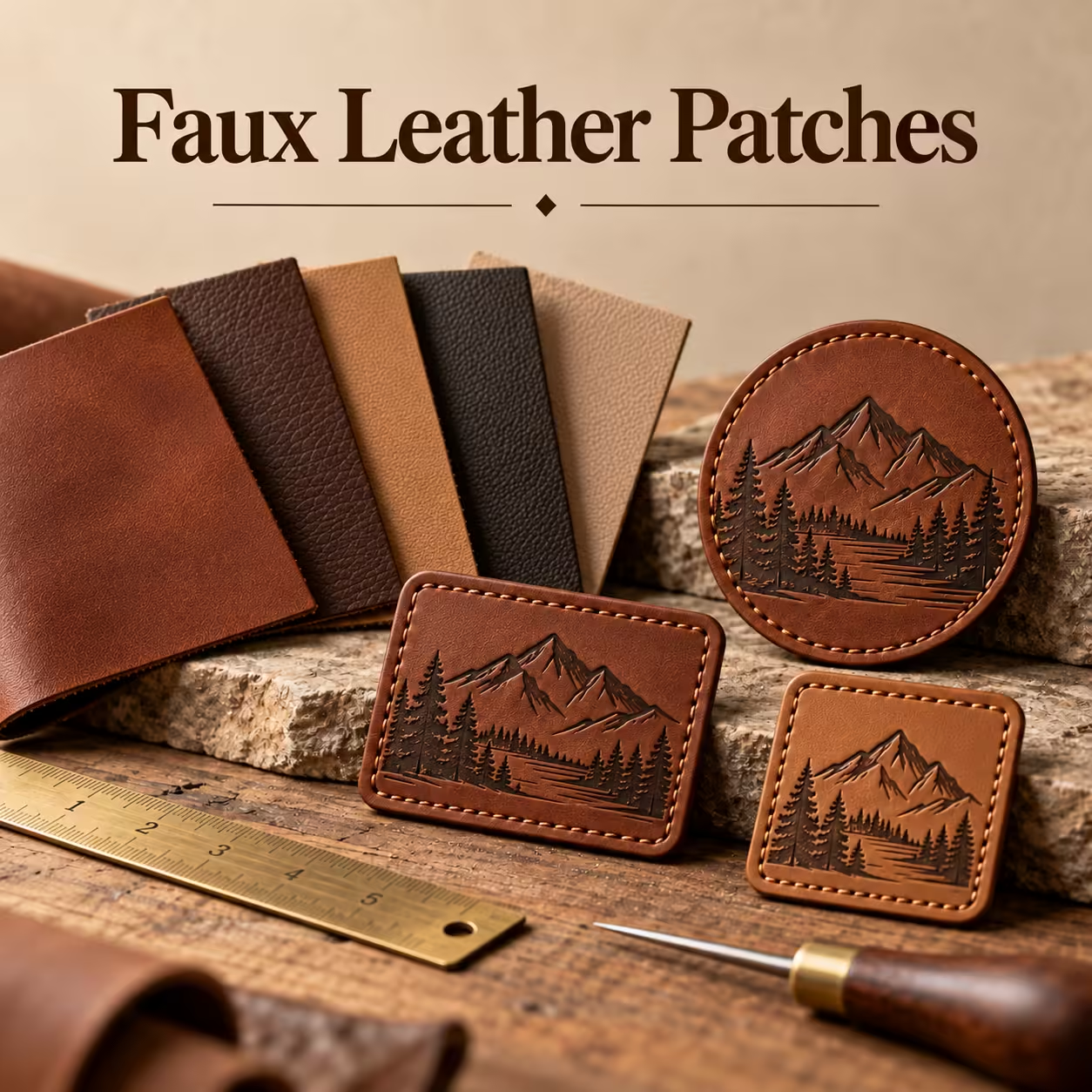
Faux Leather Patches
Faux leather patches are branded emblems made from a synthetic leather-look substrate, commonly PU-coated fabric. They offer a controlled surface for consistent labels and logos, while their suitability for engraving, pressing, heat-seal or washing depends on the exact construction.
On this page · 13 sections
- What Are Faux Leather Patches?
- How PU Leather Is Constructed
- Advantages of Faux Leather Patches
- Limitations of Faux Leather
- Debossed Faux Leather Patches
- Embossed Faux Leather Patches
- Laser-Engraved Faux Leather Patches
- Heat-Seal and Backing Options
- Colours and Batch Consistency
- Best Uses
- Faux vs Genuine Leather Patches
- FAQs
- Turn the details into a clear specification
What Are Faux Leather Patches?
Faux leather patches reproduce the look of leather using a manufactured sheet rather than hide. The face can carry a pressed, engraved or printed design when compatible. Specify the substrate rather than treating faux leather as one uniform material.
How PU Leather Is Constructed
PU leather commonly combines a polyurethane surface with a supporting fabric layer. The coating gives the face its appearance, while the backing contributes strength and flexibility. Coating thickness and formulation change how the sheet behaves during decoration and wear.
Advantages of Faux Leather Patches
Faux leather offers a repeatable face, controlled texture and an alternative to animal hide. These features are useful for coordinated brand collections and repeated labels. Confirm the composition of the entire patch before making broader animal-free claims.
Limitations of Faux Leather
Faux leather limitations depend on the coating and backing. Unsuitable heat, solvents or repeated flexing can affect the surface, and wear does not produce natural hide patina. The term synthetic should not be taken as a promise of waterproof or washable construction.
Debossed Faux Leather Patches
Debossed faux leather uses pressure to form a recessed logo in a compatible surface. Open shapes help maintain a clear impression. A test on the chosen stock is needed because one PU construction can respond differently from another.
Embossed Faux Leather Patches
Embossed faux leather requires a construction that supports raised relief without unwanted distortion. The face and fabric support work together during shaping. Compare the raised logo after forming rather than assessing suitability from the blank sheet alone.
Laser-Engraved Faux Leather Patches
Laser-engraved faux leather must be expressly suitable for laser processing. Purpose-made materials can expose a contrast layer, but unspecified leatherette can contain incompatible constituents. Material identification is essential before discussing detail, tone or engraving settings.
Technical reference: Trotec: materials suitable for laser processing. This reference does not establish our stock or service specifications.
Heat-Seal and Backing Options
Faux leather can be supplied with sewing, removable or qualified adhesive constructions. Heat-seal compatibility depends on the coating, backing adhesive and receiving garment. Request the instructions for that combination rather than using a temperature copied from another patch product.
Colours and Batch Consistency
Manufactured surfaces can provide consistent colour and grain across a run. Stock changes can still alter the result between orders. Keep a reference swatch and specification for repeat branding, especially when patches appear on adjacent products.
Best Uses
Faux leather suits compact cap branding, garment labels and coordinated batches when its construction matches the product. It can support an animal-free brief, subject to component confirmation. Care and attachment remain application-specific decisions.
Hats
A cap front needs a patch that follows the crown without crowding the peak or panel seams. Test the outline on the actual cap model.
Workwear
Workwear branding must suit the cleaning routine and exposure. A strong-looking patch is not evidence of industrial-wash compatibility.
Labels
Clothing labels need a readable brand mark in the available placement area. Keep care compatibility and any separate product information requirements in the specification.
Bulk runs
Bulk runs benefit from a clearly identified material batch and variant schedule. Keep the approved colour and artwork references for repeat production.
Faux vs Genuine Leather Patches
Faux leather supplies a manufactured appearance; genuine leather supplies natural grain and potential patina. Select the property that matters for the brand, then check the finished patch against the product. The comparison page explains the material trade-offs in more detail.
FAQs
Are PU leather and faux leather identical terms?
PU is one type of synthetic coating used in faux leather. Faux leather is the broader category and does not identify one construction.
Can faux leather peel?
Some coatings can deteriorate under unsuitable wear or care. Request material-specific information rather than a universal lifespan claim.
Can faux leather be debossed?
Compatible stock can carry a pressed impression. The chosen construction and artwork need assessment.
Turn the details into a clear specification
Send your logo, dimensions and quantity with the material choices discussed above. Include the receiving product and any wash or delivery requirements so the quotation can address your intended use.