Laser-Engraved Leather Patches
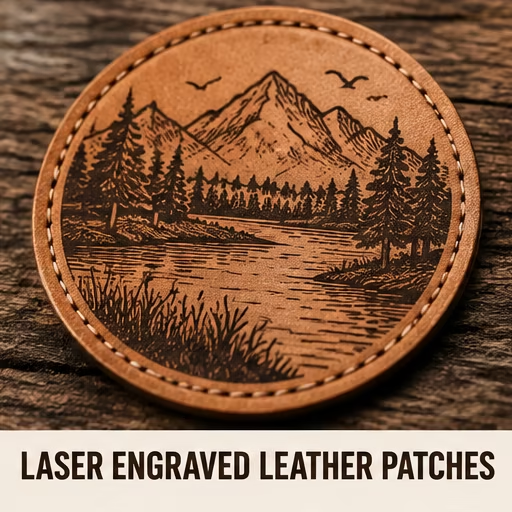
Laser-engraved leather patches use a focused laser to mark or remove surface material along a digital design. The result can reproduce fine lines and lettering, while the leather or laser-compatible synthetic substrate determines the visible tone and contrast.
On this page · 13 sections
- What Are Laser-Engraved Leather Patches?
- How Laser Engraving Works on Leather
- Best Leather for Laser Engraving
- How Much Detail Can Engraving Hold?
- Engraved Leather Patch Colours
- Shapes and Edge Cutting
- Backing Options
- Best Uses
- Laser Engraving vs Debossing
- Artwork Requirements
- How to Order
- FAQs
- Turn the details into a clear specification
What Are Laser-Engraved Leather Patches?
Laser-engraved leather patches carry a design formed by controlled laser energy rather than a pressed logo die. The mark can darken a natural surface or expose a contrasting layer in a purpose-made synthetic material. Appearance depends on the specific stock.
How Laser Engraving Works on Leather
Laser engraving follows artwork instructions that define the marked areas and paths. Cutting and engraving are separate operations even when one machine performs both. Material tests establish a useful result; there is no single setting that suits every leather.
Laser path
The laser follows prepared artwork paths or marked areas. Separate engraving instructions from cutting contours and remove accidental duplicate lines.
Burn tone
The visible engraving tone depends on the substrate and process. A material sample is needed to establish the actual colour response.
Cutting and engraving
Cutting forms the outline while engraving creates the graphic. Keeping these operations distinct in the artwork helps avoid unintended cuts through the logo.
Best Leather for Laser Engraving
Leather chosen for engraving must be suitable for the laser process. Natural stock varies in its response, and synthetic leather needs an explicit compatibility check. Do not assume that an unspecified PU or leatherette sheet is safe because it resembles a laser-ready material.
Genuine leather
Genuine leather identifies an animal-derived material, not one fixed quality grade. Grain, finishing and thickness determine its practical behaviour in a patch.
Faux leather safety and suitability
Use synthetic stock explicitly confirmed as laser-compatible. Unspecified leatherette may contain unsuitable constituents; appearance and a broad PU label are not enough to establish suitability.
Technical reference: Trotec: leather laser processing. This reference does not establish our stock or service specifications.
How Much Detail Can Engraving Hold?
Engraving can retain fine detail, but final readability still depends on scale, grain and contrast. A line visible on an enlarged screen may disappear on a small cap patch. Test the smallest lettering and the spaces inside a crest at finished size.
Fine lines
Fine lines require enough contrast and spacing to remain visible on the textured face. A clean digital path does not guarantee a readable physical line.
Small text
Small text needs open counters, useful spacing and enough contrast. Inspect the actual words at finished size instead of judging an enlarged proof.
Crests
Crests need separation between their internal elements. Test small lettering and linework at actual size, and simplify details that do not contribute to recognition.
Engraved Leather Patch Colours
Engraved colour comes from the substrate’s reaction or exposed contrast layer. It is not automatically a selectable ink colour. Ask to see the intended material combination if the logo requires a particular light-on-dark or dark-on-light appearance.
Shapes and Edge Cutting
The patch outline and engraving path should be supplied as separate, clearly identified elements. Rounded corners can simplify a stitch route, while intricate outlines need adequate strength around narrow projections. Edge appearance depends on the cutting process and material.
Backing Options
Engraved patches can be sewn, made removable or paired with another approved backing. Decoration does not establish attachment compatibility. Keep the engraving clear of the stitch margin and specify the complete construction before approving the file.
Best Uses
Engraving is useful for detailed hat logos, compact labels and crests that need internal linework. Contrast can be more important than depth on a small patch. A simpler mark may remain the better choice when the emblem is viewed from a distance.
Hats
A cap front needs a patch that follows the crown without crowding the peak or panel seams. Test the outline on the actual cap model.
Labels
Clothing labels need a readable brand mark in the available placement area. Keep care compatibility and any separate product information requirements in the specification.
Small logos
Small logos benefit from one dominant recognisable element. Removing secondary text can improve clarity without increasing the patch size.
Detailed crests
Crests need separation between their internal elements. Test small lettering and linework at actual size, and simplify details that do not contribute to recognition.
Laser Engraving vs Debossing
Laser engraving changes the surface along a digital design; debossing presses a recess with tooling. Compare engraving for intricate artwork and debossing for a more pronounced pressed character. Material and proof size should remain constant when judging the difference.
Artwork Requirements
Engraving artwork should have clean paths, readable lettering and no accidental duplicate lines. Separate cut contours from artwork and indicate the final dimensions. A scannable code requires testing on the finished physical patch; a clear digital image is not enough.
How to Order
Send the original logo, desired dimensions, preferred substrate and quantity for an engraving assessment. Mark any details that must remain. Confirm the material, engraved contrast, backing and proof revision together before production is authorised.
FAQs
Does engraving always make leather black?
No. The visible tone depends on the stock and process, and some synthetic materials expose a contrasting layer.
Can a leather patch carry a QR code?
Only rely on a code after testing it on the finished patch under realistic conditions. Grain, distortion and low contrast can prevent scanning.
Is every faux leather laser-safe?
No. Use positively identified, laser-compatible material; unspecified leatherette is not enough.
Turn the details into a clear specification
Send your logo, dimensions and quantity with the finish choices discussed above. Include the receiving product and any wash or delivery requirements so the quotation can address your intended use.