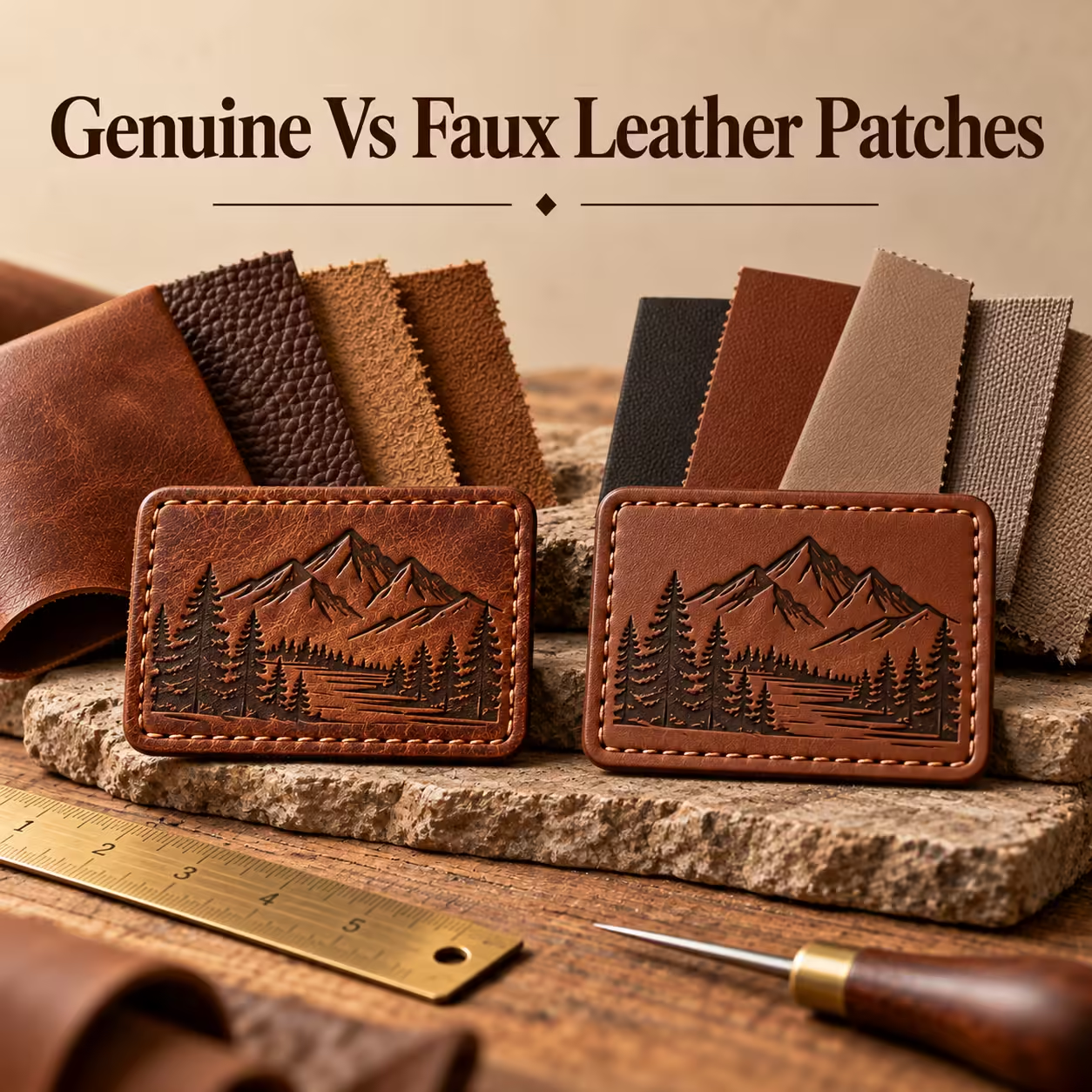
Genuine vs Faux Leather Patches
Genuine leather patches provide natural grain and potential patina; faux leather patches provide a manufactured leather-look face with more controlled surface consistency. Choose between them by appearance, animal-free requirements, attachment and care rather than by a universal quality ranking.
On this page · 14 sections
- What Is a Genuine Leather Patch?
- What Is a Faux Leather Patch?
- Texture and Appearance
- Patina and Ageing
- Colour Consistency
- Heat and Backing Compatibility
- Durability and Cleaning
- Price and Production Consistency
- Which Is Better for Hats?
- Which Is Better for Clothing Labels?
- Which Is Better for Workwear?
- Comparison Table
- FAQs
- Turn the details into a clear specification
What Is a Genuine Leather Patch?
A genuine leather patch is made from animal hide that has been processed into leather. Its grain, surface finish and thickness determine the result on a garment. The word genuine identifies the material; it does not specify a particular premium grade.
What Is a Faux Leather Patch?
A faux leather patch uses a manufactured leather-look substrate, often a coated fabric. PU is one possible coating, not a guarantee of a specific performance. Confirm the composition and complete construction when an animal-free specification is important.
Texture and Appearance
Genuine leather can show natural variation in grain and markings. Faux leather can reproduce an embossed grain more consistently across a sheet. Compare the finished logo as well as the blank texture, because decoration changes the visual result.
Patina and Ageing
Genuine leather can develop changes in tone and feel through handling and exposure. Faux leather ages according to its coating and backing rather than developing the same hide patina. Neither material’s ageing should be described as a fixed or identical process.
Colour Consistency
Faux leather often gives a more uniform face within a batch, while natural hide can vary across a single piece. Both can vary between stock batches. Agree a physical colour reference if labels will appear together on a coordinated product collection.
Heat and Backing Compatibility
Sewing avoids activation heat for either material. Heat-seal requires a qualified substrate-and-adhesive construction, and faux leather is not automatically safe under an iron. Confirm the garment compatibility and application instructions before selecting a heat-applied option.
Durability and Cleaning
Cleaning performance follows the specific leather, coating, finish and backing. Genuine leather can react to soaking or excessive heat; synthetic coatings can also deteriorate under unsuitable care. Follow instructions for the finished patch rather than assuming faux means machine washable.
Price and Production Consistency
Price and consistency depend on the actual stock and manufacturing requirements. A synthetic sheet may reduce natural variation, while premium synthetic constructions can cost more than basic leather. Compare equivalent finished specifications instead of relying on a simple real-versus-faux price rule.
Which Is Better for Hats?
For hats, choose genuine leather when natural character is central and compatible care is practical. Choose faux leather when a controlled surface or animal-free substrate is the priority. In both cases, check whether thickness and backing follow the crown comfortably.
Which Is Better for Clothing Labels?
For clothing labels, the garment’s cleaning instructions are a primary constraint. Faux leather can offer consistent branding across a range, while genuine leather can contribute a changing natural appearance. Confirm wash compatibility rather than selecting only by the label’s initial look.
Which Is Better for Workwear?
For workwear, neither category alone establishes industrial-laundering suitability. Assess abrasion, exposure and the intended wash process. A removable patch can simplify care separation, but the loop panel and garment must still tolerate their cleaning routine.
Comparison Table
The table compares material characteristics rather than assigning a winner. Use the differences to narrow the specification, then request approval of the exact stock, finish and backing for your application.
| Attribute | Genuine leather | Faux leather |
|---|---|---|
| Composition | Animal-derived leather | Manufactured leather-look substrate |
| Texture | Natural grain or finished face | Engineered grain or smooth face |
| Ageing | Can develop patina depending on finish | Coating and support age according to construction |
| Consistency | Natural variation expected | Usually a more controlled sheet face |
| Heat application | Only with qualified construction | Only with qualified construction |
| Cleaning | Material-specific instructions | Coating-specific instructions |
| Animal-free brief | Does not meet an animal-free hide requirement | Confirm all components, not just the face |
FAQs
Is faux leather automatically vegan?
Do not infer the whole patch composition from the face material alone. Confirm coatings, adhesive and backing against the required specification.
Does genuine leather always cost more?
No universal rule applies. Compare the actual stock, decoration and complete order requirements.
Can either material go through industrial washing?
Only if the complete construction is qualified for that routine. Material names alone do not establish it.
Turn the details into a clear specification
Send your logo, dimensions and quantity with the material choices discussed above. Include the receiving product and any wash or delivery requirements so the quotation can address your intended use.